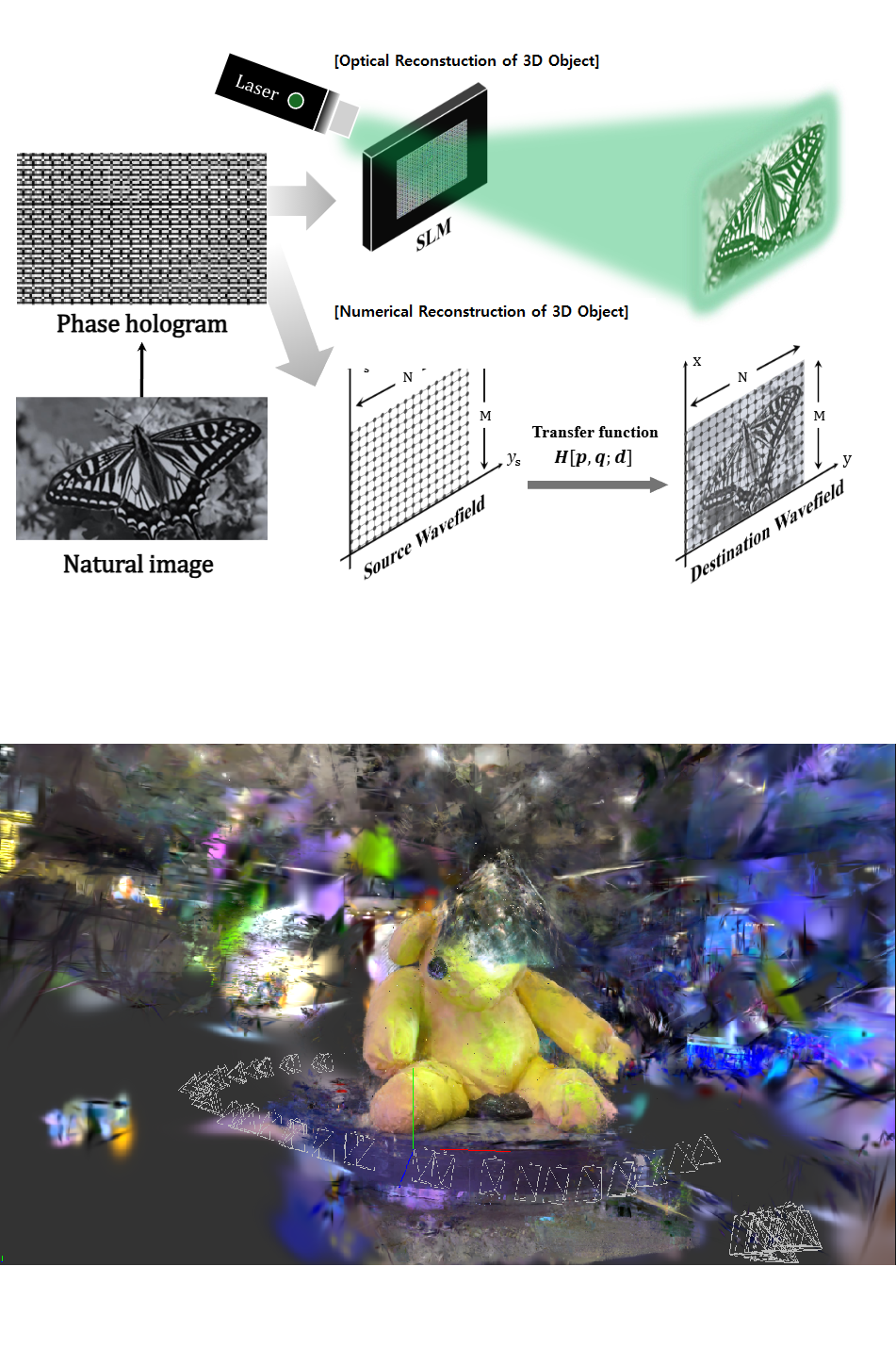
The 3D Video Coding (3DV) team conducts research across two major frontiers of next-generation 3D media: phase-aware hologram compression (Learned-based/hand-crafted based) and 3D Gaussian Splatting (3DGS)
Holography reproduces the full light field of objects in space, eliminating the vergence-accommodation conflict of conventional 3D displays. Phase hologram data, however, has two properties that make standard image processing fundamentally unsuitable:
3DV formalizes both properties at every layer of the pipeline — from conventional codec extensions (HEVC, VVC) to end-to-end neural video compression (NHVC), phase-aware activation functions (FlexMU), and neural hologram generation under variable propagation conditions (PaD). The team’s work spans 17+ publications and 22+ patent applications, with industry partnerships at Samsung and ETRI.
3DGS represents 3D scenes as millions of learnable Gaussian ellipsoids, enabling real-time novel-view synthesis at >100 fps — far exceeding NeRF in speed.
Standard video codecs treat all signals as living on a linear number line.
Phase signals live on a circle, so conventional difference computation, clipping, and RD optimization all produce incorrect results.
We introduced two foundational operations and integrated them into HEVC’s RDO, residual computation, and sample reconstruction processes:
Applied across seven holographic test sequences, the proposed method achieves –63.3% BD-Rate (phase domain) and –65.5% BD-Rate (NR domain) compared to standard HEVC. VVC extensions with SAO and deblocking filters are submitted.
Conventional approaches treat hologram generation and compression as separate pipelines. NHVC is the first unified end-to-end neural holographic video codec, jointly optimizing generation and compression within a single scalable architecture.
Key design choices:
NHVC achieves >33 dB NR-PSNR quality, outperforming cascaded baselines by –75.8% BD-Rate (image) and –75.6% BD-Rate (video).
Phase holograms are shift-invariant: adding a global constant (mod 2π) leaves the 3D reconstruction unchanged. This means two physically identical holograms can show arbitrarily large phase-domain error — making direct phase comparison unreliable.
PDA (Phase Distribution Alignment) maps each hologram to a unique canonical form before computing error, resolving this ambiguity. PDA-based metrics show consistently higher correlation with NR-domain metrics across 13 noise types and 5 strength levels.
PDA has three demonstrated applications:
Existing neural hologram generators are optimized for a fixed propagation distance.
Changing the distance, wavelength, or pixel pitch requires full retraining — impractical for real deployments where hardware specifications vary.
PaD (Propagation as Data) treats the propagation kernel as input data rather than a fixed physical operation baked into the architecture. A dedicated Kernel Encoder ingests the propagation kernel at inference time, enabling a single trained model to generalize to arbitrary propagation conditions without retraining.
Architecture highlights: pre-trained LDM image encoder for stable feature extraction; FFC (Fast Fourier Convolution) for feature–kernel fusion; enlarged receptive field for global scene structure modeling.
| Title | Venue | Year | |
|---|---|---|---|
| Phase Distribution Matters: On the Importance of Phase Distribution Alignment (PDA) in Holographic Applications | Proceedings of the 33rd ACM International Conference on Multimedia. 2025. | 2025 | DOI |
| Distribution-Shifting: Novel phase-distortion metrics for hologram processing | 2024 IEEE Conference Virtual Reality and 3D User Interfaces (VR) | 2024 | DOI |
| NHVC: Neural Holographic Video Compression with Scalable Architecture | 2024 IEEE Conference Virtual Reality and 3D User Interfaces (VR) | 2024 | DOI |
| P-Hologen: An End-to-End Generative Framework for Phase-Only Holograms | Pacific Conference on Computer Graphics and Applications (Pacific Graphics) | 2024 | DOI |
| Propagation as Data (PaD): Neural phase hologram generation with variable distance support | 2024 IEEE Conference Virtual Reality and 3D User Interfaces (VR) | 2024 | DOI |
| VVC 기반의 위상 홀로그램 압축 | 2024년 한국방송미디어 공학회 하계학술대회 학부생 논문 | 2024 | |
| 위상 홀로그램 압축 기술 동향 | 실감미디어 디스플레이 및 표준화 동향 | 2024 | |
| 위상 홀로그램의 픽셀피치 변화에 따른 적정 전파거리에 대한고찰 | 방송공학회논문지 | 2024 | DOI |
| DHM을 위한 간섭무늬 압축 방법과 위상 압축 방법의 성능 비교 | 2023년 1월 홀로그래픽 신호처리 특집호 방송공학회논문지 | 2023 | DOI |
| HEVC extension for phase hologram compression | Optics Express | 2023 | DOI |
| 신경망 기반 블록 단위 위상 홀로그램 이미지 압축 | 2023년 1월 홀로그래픽 신호처리 특집호 방송공학회논문지 | 2023 | DOI |
| 전파거리에 따른 위상 홀로그램 복원성능 분석 및 BL-ASM 개선 방안 연구 | 2023년 1월 홀로그래픽 신호처리 특집호 방송공학회논문지 | 2023 | DOI |
| 디지털 홀로그래픽 현미경 데이터를 위한 위상 영상 압축 | 2022년 한국방송미디어 공학회 하계학술대회 대학생 논문 | 2022 | |
| 복소 홀로그램 표현방식에 따른 압축 성능 분석 | 2022년 한국방송미디어 공학회 하계학술대회 학부생 논문 | 2022 | |
| 심층 학습 기반 위상 홀로그램 생성 | 2022년 한국방송미디어 공학회 하계학술대회 학부생 논문 | 2022 | |
| 순환 손실 함수를 이용한 딥러닝 기반 위상 홀로그램 초해상도 | 2021년 한국방송미디어 공학회 추계학술대회 대학생 논문 | 2021 | |
| 위상 홀로그램 동영상 압축 성능 분석 | 2020년 한국방송미디어 공학회 추계학술대회 | 2020 |